 daylight machines
If you have ADHD, you might know this feeling: you sit down at 10 AM, and the next time you look up it’s 1 PM. Not because time flew — but because your brain simply didn’t register those three hours passing. They just… weren’t there.
In the late 1990s Dr. Russell Barkley, coined the term “Time Blindness” for this. In his words: “The behavior of those with ADHD is more controlled by the temporal now than by internally represented information pertaining to past and future”.1 In this post I want to explain what’s actually going on when it happens, why most clocks don’t help as much as they should, and how a linear clock might be a part of the puzzle.
Now vs. not now
The research is clear. A 2021 meta-analysis looked at 55 studies and found that people with ADHD have what researchers call an accelerated internal clock. The brain’s time-keeping mechanism runs fast, which makes elapsed time feel longer than it actually was — or, more often, makes you lose track of it altogether.2 A second meta-analysis of 27 studies found the same pattern, with effect sizes large enough that researchers aren’t debating whether the deficit exists anymore. It clearly does.3

The ADHD community has its own way of describing this, and it’s remarkably consistent across forums, blogs, and social media. Everything gets sorted into two categories: “now” and “not now.” Tomorrow’s deadline and next year’s vacation sit in the same foggy bucket of “not now.” There’s no gradient, no sense of one being closer than the other.4 And then suddenly something that was “not now” becomes “now” and it triggers that familiar, last-minute scramble.
The issue with most clocks
Here’s where clock design becomes relevant. The research supports a clear principle: if the brain’s internal clock can’t be trusted, the next best thing is to offload time-keeping to your eyes. Make time something you can see rather than something you have to feel.5
Any clock helps with this to some degree. But not all formats work equally well for time-blind people.
A digital clock gives you a number: 2:47. To make that useful, you need to calculate — how long until 3:00? How much afternoon is left? When should I start getting ready? Each of those questions pulls on working memory, which is already running low with ADHD.6

An analog clock is better. The hands show spatial relationships, and their movement gives a continuous sense of time passing. But a circular clock has a fundamental limitation for time blindness: it doesn’t show the whole day. The dial cycles twice every 24 hours. 2 PM and 2 AM sit in the same spot. And the circle has no endpoint — it just keeps going around, subtly implying that time is an infinite loop. For a brain that already can’t feel the day running out, that’s exactly the wrong message.
Visualizing context
This is where a linear clock could be different. It shows the full day as a horizontal line, left to right, and tracks your position as the hours pass. That format does something different from any circular or digital clock.
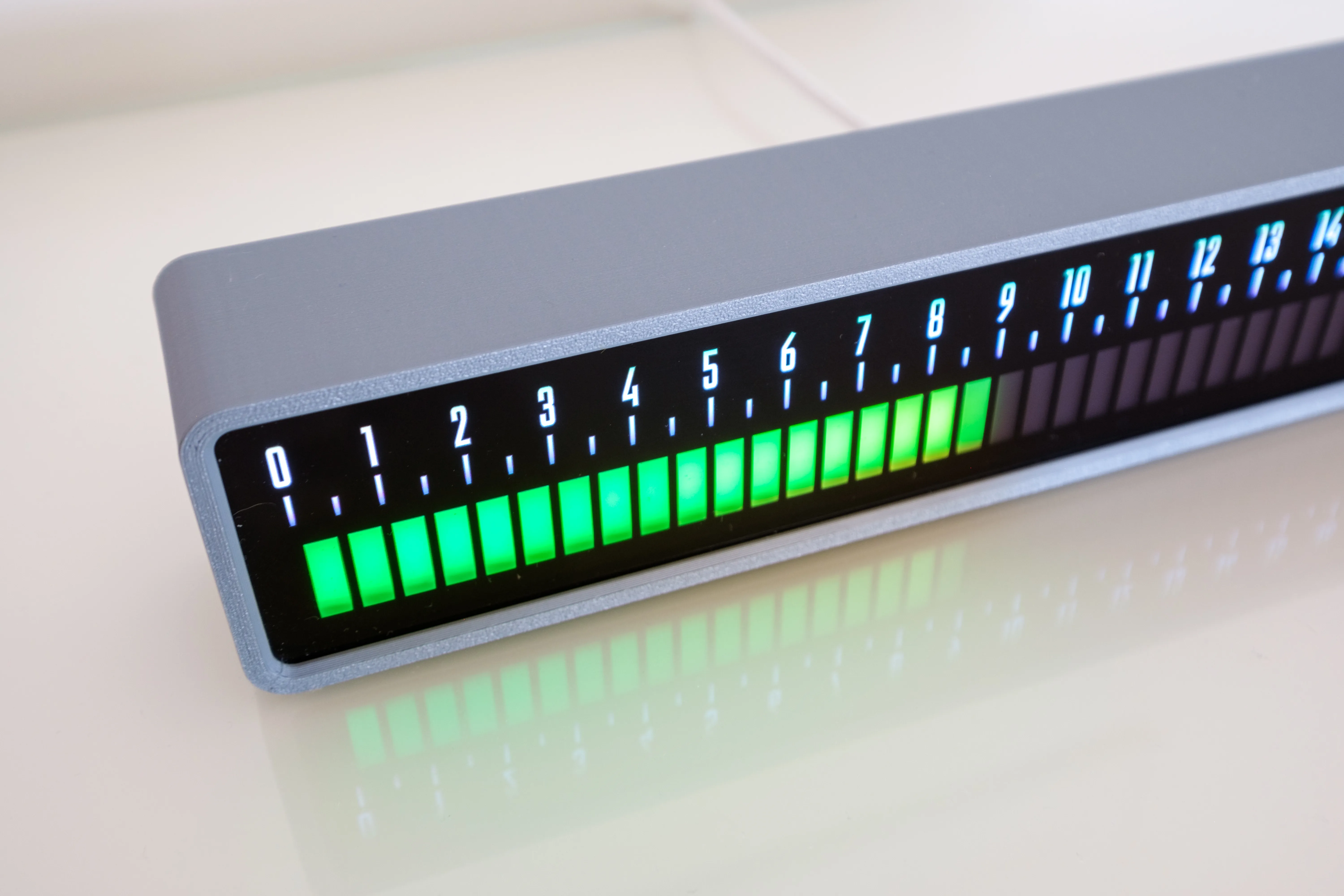
It shows the day the way it actually works: as something that starts, progresses, and ends. The part that is not yet lit, shows the time you have left. There’s no ambiguity and no calculation needed. You can see that it’s mid-afternoon and the evening is approaching. You can feel, visually, that the day is a finite thing being spent.
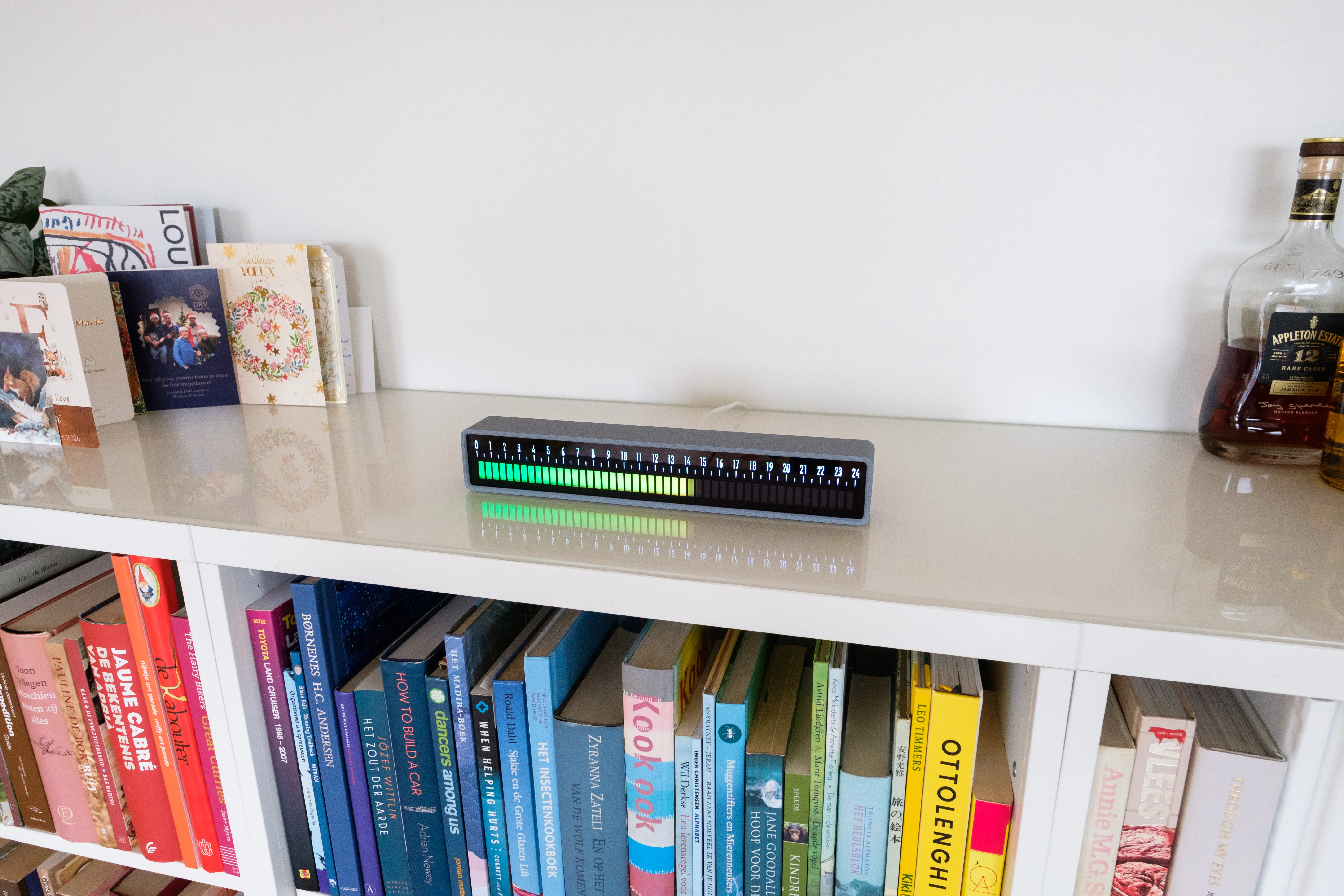
This also matches how we already think about planned time. Timelines, schedules, progress bars, Gantt charts — we almost always draw time as a horizontal line when we’re trying to make sense of it. A linear clock puts that familiar mental model on your desk and keeps it updated in real time.
And maybe most importantly for time blindness: it gives every moment context. On a digital clock, 2:30 PM is an isolated number. On a linear clock, 2:30 PM is a position — you can see its relationship to the start and the end of your day. That spatial context is exactly what time blindness strips away.1 It answers “where am I in the day?” continuously and passively.
The bottom line
The neuroscience of time blindness is well-established. Multiple meta-analyses confirm that ADHD involves measurable deficits in time perception.23 Seeing time progress clearly, can be part of the puzzle to deal with the consequences of this blind spot. 15
A linear clock applies that principle more completely than other formats. It shows the whole day, as a finite resource, with spatial context for every moment. It takes the thing that temporal myopia removes — a felt sense of the day’s shape and progression — and puts it right in front of your eyes.
If you’re interested, check out more information on the linear clock here!
Footnotes
-
Barkley, R.A. (1997). “ADHD, self-regulation, and time: toward a more comprehensive theory.” Journal of Developmental and Behavioral Pediatrics. PubMed ↩ ↩2 ↩3
-
Marx, I. et al. (2021). “Meta-analysis: Altered Perceptual Timing Abilities in ADHD.” Journal of the American Academy of Child & Adolescent Psychiatry. 55 studies. ScienceDirect ↩ ↩2
-
Zheng, Q. et al. (2022). “Time Perception Deficits in Children and Adolescents with ADHD: A Meta-analysis.” Journal of Attention Disorders. 27 studies, Hedges’ g > 0.40 for accuracy, 0.66 for precision. SAGE Journals ↩ ↩2
-
ADHD Homestead. “How it really feels to be time-blind with ADHD.” ADHD Homestead ↩
-
ADDitude Magazine. “Analog Clocks for ADHD Brains: Benefits of Seeing Time Pass.” ADDitude ↩ ↩2
-
Weissenberger, S. et al. (2021). “Time Perception is a Focal Symptom of ADHD in Adults.” Medical Science Monitor. PMC ↩